Gameplay document · Apr 2026
Solara
Animal Crossing meets Stardew Valley, set inside a Studio Ghibli sunrise.
A cozy mobile farming game where you bring an abandoned planet back to life by terraforming, sending drones, and salvaging the ruins of the old civilization.
01
Overview
Player fantasy
You're a small soul on a long, quiet pilgrimage.
The world is dead but not hostile — it's just waiting. You're the patient hand that brings it back, one tile at a time. Every time you show up, something more is growing — and slowly, a green town you've built with your own hands appears around you, full of warmth and quiet nostalgia for a life that was almost lost.
Target audience
Cozy-game players aged 22–45 who already love Stardew Valley and Cozy Grove, with a meaningful tail of older players who appreciate quiet pacing. They play in semi-long evening sessions (15–30 min before bed) and shorter commute pickups (5–10 min). They want more emotional weight than Hay Day offers, but on a mobile-friendly schedule. They're patient. They like the slow build. They're not chasing leaderboards.
What makes Solara different
Your farm is contagious. A living mycelium network spreads from every crop you grow, healing the soil tile by tile, and the planet itself visibly transforms from rust to green as your reach expands. Drones keep working while you're away, salvaging the ruins of the old civilization for fragments of lore and craft materials. There are no enemies and no failure states — the world is dead but not hostile, just waiting. Solara takes the comfort of cozy farming and gives it a cause: you're not building a farm, you're reviving a planet.
Comparable titles
- Stardew Valley — emotional weight
- Cozy Grove — daily rhythm
- Spiritfarer — patient stewardship
02
Core gameplay loop
Solara has two nested loops: the 60-second moment-to-moment loop, and the daily ritual that frames it.
60-second loop
Every time the player opens the app, this is the rhythm:
- Open. See the outpost, slightly greener than yesterday. Drones have left gifts.
- Plant. Tap empty tiles to drop seeds. Compatible neighbors give bonuses.
- Tend. Water, fertilize with compost from yesterday's harvest.
- Harvest. Mature crops bloom with a particle pop. Tap to collect.
- Dispatch. Send drones to scout, salvage, or harvest in unlocked regions.
- Spread. Every harvest extends the mycelium network one tile. The world map gains a fraction of green.
Daily ritual (15–30 min session)
Wraps the 60-second loop with longer activities the player chooses to do or not:
- Solve one terraforming puzzle to revive a dead tile in a new region
- Read a salvaged lore fragment from V's old greenhouse notes
- Trade with a passing merchant or returning villager
- Restore one piece of an old ruin, unlocking a new recipe or building
- Attend a seasonal festival if one is active that day
Weekly cadence
A new region opens roughly once per week of regular play. A new villager arrives every 2–3 regions. A festival runs for 3 days every 2–3 weeks.
03
Key mechanics
3.1 The mycelium spread
The signature mechanic
Solara's defining system. Your farm is connected to the planet through a living underground fungal network that physically spreads outward as you grow crops.
How it works
- Each successful harvest extends the mycelium one tile in a chosen direction. The player picks which way it grows.
- Visible underground veins glow softly under reclaimed soil. At dusk and night, they pulse with the project's sacred mycelium-coral color.
- Mycelium reaching a new region unlocks scouting access. The player can now send drones there.
- Mycelium reaching a ruin reveals what's inside without needing a salvage trip — a passive lore reward.
- No backward growth. The mycelium only spreads forward. Land you reclaim stays reclaimed.
Why it works as a differentiator
Most cozy farms are gated — you unlock new tiles by paying or grinding. Solara's is contagious. Your farm is medicine that spreads to the world around it. Watching the network spread is the progression.
3.2 Drones (idle helpers)
What players do when they're not playing
The player has access to up to three drones, each with a distinct role. They keep working while the app is closed.
| Drone | Role | Idle time |
|---|---|---|
| Scout | Reveals new regions on the planet map. Sent to a target tile, returns with terrain data. | 2–6 hours |
| Salvage | Excavates ruins. Returns with artifacts (craft materials), data slates (lore), and occasionally seeds. | 4–12 hours |
| Harvest | Auto-collects mature crops while the player is away. Cannot plant — only collect. | Always on |
Drones are the cozy answer to the energy mechanic in other mobile games. The player never feels they're wasting time by not playing — they're always making progress, even when away. Coming back to find what the drones brought is part of the daily reward ritual.
3.3 Salvage (the lore engine)
How the world's past gets revealed
Every ruin on Solara was built by the previous civilization, abandoned a hundred years before the player arrived. Salvaging is the mechanic that lets the player reconstruct what happened.
Salvage outputs
- Craft materials. Recovered metal, glass, wiring, fabric. Used to repair buildings and craft tools.
- Data slates. Fragments of writing, audio, or images from the previous civilization. The primary lore delivery method.
- Heirloom seeds. Old crop varieties that no longer grow naturally. Each one unlocks a new tile combination for terraforming puzzles.
- V's notes. The most valuable salvage. Each one advances the central narrative arc.
3.4 Terraforming puzzles
The cozy answer to "puzzle mechanic"
To restore a dead tile to a state where it can grow crops, the player solves a small puzzle. Each puzzle takes 30–60 seconds.
Puzzle structure
- A 3×3 grid of dead tiles, each with one or two hidden environmental conditions (dry, salty, acidic, contaminated, etc.)
- The player has a hand of seeds, each one tagged with what condition it cures
- Plant compatible seeds next to each other for combo bonuses (companion planting — marigold + tomato + bean is the classic Three Sisters combo)
- Solve the grid: every dead tile becomes living
- On solve: the tile is added to the player's reclaimed area, the mycelium spreads, the planet map updates
Puzzles teach real permaculture (companion planting), feel like a quick brain exercise, and end with a satisfying "the desert turned green" reveal.
3.5 Trade and community
How the world feels populated
No social features. No friends list. No leaderboards. Solara is single-player.
Instead, the world fills with NPCs over time — botanists, engineers, traders, beekeepers — each with their own backstory, daily routine, and occasional requests. The player trades produce for tools, helps villagers fix things, and slowly grows a town.
NPC request types
- Direct trade. "3 lavender + 1 honeycomb for my grandmother's tea recipe."
- Restoration help. "I want to fix my windmill. Bring me 4 copper and 2 wood."
- Quiet companionship. "Visit me at dusk — I'll tell you a story about V."
3.6 Seasonal festivals
Live ops, but cozy
Every 2–3 weeks, the village hosts a 3-day festival. Each festival ties to a real-world season but is reframed for Solara's context.
- Spring Bloom. Celebrates the first crops to flower this cycle. Players plant rare flower bulbs that only grow during the festival.
- Sun Harvest. Solar tech festival — players craft new lanterns and panels. Marsh teaches a new repair recipe.
- Lantern Night. Quiet evening festival. Players light lanterns along the mycelium veins. The map glows for 24 hours.
- Seed Exchange. Trading festival. Wandering merchants visit with rare seeds the player can't get otherwise.
Festivals are designed to be rewarding without being demanding. Missing one is fine — they return.
04
World structure
The planet
Solara is one planet, not infinite. The full world is hand-designed, not procedurally generated. Players need to feel they're getting to know it, not exploring randomness.
Regions
Five to seven distinct regions, each a different biome. The player's starting region is the central plain. From there, the mycelium spreads outward.
| Region | Character | Unlock |
|---|---|---|
| Central Plain | Player's starting region. Mild climate, balanced soil. The first crops grow here. | Start |
| Rust Flats | Vast desert of red iron-rich soil. Hardest terraforming puzzles. First major ruins. | Hour 4 |
| Dust Hollow | Crater-like depression. The previous civilization's greenhouse complex. Holds V's notes. | Hour 12 |
| Coastal Marsh | First reach of the sea. Brackish soil. Unlocks aquatic farming. | Hour 20 |
| Bone Forest | Petrified woodland. Slowly returning to life. Salvage-rich. Late-game lore. | Hour 30 |
| Cloud Ridge | Mountain plateau. Where the wind turbines were. Most remote. | Hour 40 |
The outpost
The player's home is not built by them. It arrives with them — a sphere lander that opens into a small dome house. This solves the "where do you start?" question and signals the game's lore: every botanist comes in their own sphere.
As the town grows, more spheres land in surrounding tiles. Each one becomes a villager's home. The visual signature of the game becomes a landscape gradually dotted with opened spheres, each one a person who came back.
05
Progression systems
Solara has three parallel progression tracks. None of them gate the others completely — the player can advance any of them at any time.
5.1 Hero progression
The player's tools and capabilities. Earned through play, never paid.
- Watering can. Tier 1 waters one tile. Tier 4 waters a 3×3 area.
- Scanner. Range increases. Unlocks new salvage detection (rare seeds, hidden lore fragments).
- Drone capacity. Start with 1 drone. Maximum 3 by mid-game. Each upgrade requires significant salvage.
- Mech companion. Mid-game unlock. A small worker mech that handles heavy tasks (clearing rubble, tilling new ground). Customizable visually.
5.2 World progression
The planet itself heals.
- Tile reclamation. Every successful farm extends the mycelium one tile.
- Region unlocks. New biomes become accessible as the mycelium spreads.
- Planet color shift. The world map literally changes color over time — rust to sage to bloom. By late game, only rare pockets of rust remain, preserved as memorial sites.
5.3 Community progression
The town grows around the player.
- Villager arrivals. Each new villager arrives in their own sphere. They bring a personality, a routine, and unlock new recipes and quest types.
- Building restoration. Old ruined buildings become workshops, libraries, kitchens. Each restored building unlocks a system.
- Festival cadence. As the town grows, festivals become more frequent and elaborate.
06
Narrative arc
Four acts. Each one unlocks at roughly the player-hour milestones below. The narrative threads through the gameplay rather than interrupting it — there are no cutscenes, only letters, salvaged notes, and conversations.
Act I — Arrival · hours 0–4 · lonely curiosity
You wake up in the lander. The atmospheric scrubbers still work but everything outside is silent. A small worker drone greets you — half-buried in sand, but functional. The first letter from V arrives, washed up at the edge of your reclaimed zone. It says: "If this works, more of us will come."
Player learns: the core loop. Plant. Wait. Spread. Salvage. The world is bigger than what they can see.
Act II — The First Returnees · hours 4–15 · quiet hope
People start arriving. Slowly. Each one comes with a reason. Ode the beekeeper. Marsh the engineer. The first community building is restored. A new region opens — Dust Hollow — fully dead, with a ruin at its center. Second letter from V: "You'll find more of my notes if you keep going."
Player learns: there are NPCs with quests, the world expands as the mycelium does, and someone has been here before.
Act III — What V Left Behind · hours 15–35 · reverent melancholy
Deeper salvage reveals the truth. V was the last person on Solara before it was abandoned — a botanist who tried to seed the planet's recovery before everyone else evacuated. She built the first mycelium network. She died here. Her notes describe what should grow, where, and why. You're not the savior. You're the second botanist.
Tessa, V's grand-niece, arrives. She came to find what V left behind. She stays. The first Returning Festival happens — the town has a name now: people are calling it Solara, after the planet itself.
Player learns: the game is not about saving Solara. It's about continuing what someone else started.
Act IV — Long Green · hours 35+ · quiet completion
There's no boss fight. There's no ending screen. The game shifts from recovery to stewardship. The mycelium spreads passively across the planet now, faster than your interventions. You've built the engine. It runs.
A library is restored — it holds V's papers and your own. Future arrivals will read both. The last salvage drone retires. Marsh frames it on the workshop wall. The final letter is from you, to whoever plays after you. The game asks: "What would you want them to know?"
Player learns: the game wasn't about completion. It was about being one link in a chain.
Themes (running across all four acts)
- Inheritance. Every important thing in Solara was started by someone else. The player inherits, then passes on.
- Patience. The game refuses urgency. The story unfolds at the speed of the planet's recovery.
- Quiet community. No villains, no rivals, no factions. Solara's tension is internal — between solitude and belonging.
07
UI & screen flow
Solara is portrait-orientation only. All UI is built around the assumption that the player is holding their phone in one hand, often before bed.
7.1 Primary screens
| Screen | Purpose |
|---|---|
| Main farm | The default home screen. Tile grid (planted / reclaimed / dead), mycelium spread bar, character avatar, four primary action buttons (Plant, Drones, Salvage, Map). |
| Planet map | The progression screen. Region nodes shown as circles, color-coded by state (healed / healing / dead / locked). Pink lines = mycelium reach. Tap a region to see options. |
| Drone hangar | Where the player dispatches drones and reviews recent salvage. Each drone shows its current status, target, and time remaining. |
| Terraforming puzzle | The mini-puzzle screen. 3×3 grid of dead tiles, hand of seeds, plant-and-spread button. Solves take 30–60 seconds. |
| Village | The community screen. Shows all NPCs currently in the village, their requests, and any active festival. |
| Library | Late-game unlock. Holds V's notes, the player's own letters, and lore fragments collected through salvage. |
7.2 What the UI is NOT
- No timed energy mechanic. The player can play as long as they want, whenever they want.
- No social layer. No friends list, no leaderboards, no "send heart to neighbor" notifications.
- No store front-and-center. Monetization, if any, lives in a quiet corner. Cosmetic seeds, decorative items, no pay-to-win.
- No tutorial overlay. The game teaches by letting the player do, not by interrupting them.
- No daily login reward popup. Drones are the daily reward. The player gets it organically.
08
Art direction
See the separate Art Direction Brief for full details. Summary follows.
Visual direction
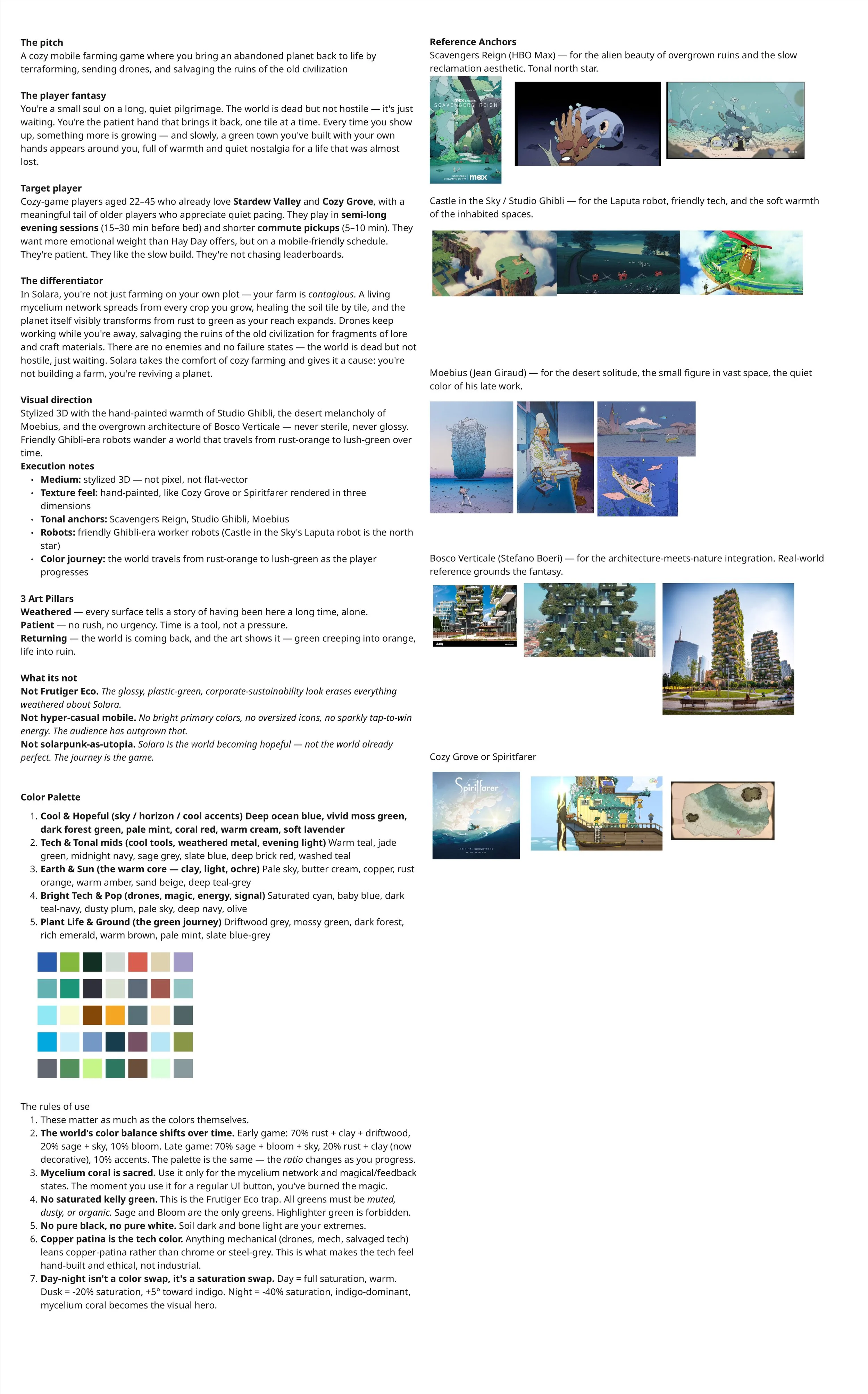
Stylized 3D with the hand-painted warmth of Studio Ghibli, the desert melancholy of Moebius, and the overgrown architecture of Bosco Verticale. Never sterile, never glossy. Friendly Ghibli-era robots wander a world that travels from rust-orange to lush-green over time.
Three art pillars
Weathered
Every surface tells a story of having been here a long time, alone.
Patient
No rush, no urgency. Time is a tool, not a pressure.
Returning
The world is coming back, and the art shows it — green creeping into orange, life into ruin.
Color journey
The world's palette shifts as the planet heals. Early game: 70% rust + clay + driftwood, 20% sage + sky, 10% bloom. Late game: 70% sage + bloom + sky, 20% rust + clay (now decorative), 10% accents.
What the art is NOT
- Not Frutiger Eco. No glossy plastic-green corporate-sustainability look.
- Not hyper-casual. No bright primary colors, no sparkly tap-to-win energy.
- Not solarpunk-as-utopia. There's still rust, decay, and work to be done. That's the point.
09
Scope & roadmap
This document describes a complete vertical slice plus a plausible long-term content roadmap. A real production would scope down significantly for v1.0.
Minimum viable game (v1.0)
- Central Plain + Rust Flats + Dust Hollow (3 regions of 6)
- Acts I and II of the narrative (V revealed in v1.1)
- Three drones, full progression to mech unlock
- Three villagers (Ode, Marsh, Tessa) plus the player
- Two festivals (Spring Bloom, Sun Harvest)
- Estimated player time: 15–20 hours
Post-launch content roadmap
- v1.1. Coastal Marsh + V's revelation (Act III)
- v1.2. Bone Forest + Lantern Night festival
- v1.3. Cloud Ridge + Seed Exchange + Act IV (the long green)
- v2.0. Player-authored content — design custom regions, name new arrivals, write letters to whoever comes next
10
Closing
Solara is a game about patience.
It refuses the things mobile cozy games are usually defined by — timed energy, social pressure, daily login streaks, hyper-casual brightness. In their place it offers a slower, sadder, more rewarding fantasy: that you arrived somewhere quietly, found something dead, and stayed long enough to bring it back.